Thursday, July 5, 2018

Hard-boiled eggs -- cooking and peeling (even fresh ones!!)


We have chickens, laying hens -- about 10 of them.  This time of year (summertime) we have a lot of eggs!  I have posted before on this blog about egg recipes, and now I'm going to talk to you about hard-boiled eggs!

If you've had fresh-from-the-coop eggs before, you know that hard boiling them and peeling them can be kind of difficult to do in a "pretty" way -- the shells are hard to peel and don't leave a nice smooth white usually.

I won't show you a picture of my ugly boiled eggs or ugly deviled eggs or anything :)

BUT I will share my secrets with you!

First of all-- the cooking/hard-boiling of the eggs.  Instead of boiling them, I steam the eggs -- in a steamer basket in my saucepan for about 8 minutes or so.  After that, I run cold water over them until they're cool to the touch.

Then comes the peeling:  I read this method online years and years ago and it really works like magic!


Step 1:  place hard cooked egg into a pint sized canning jar


Step 2: put a little water into the jar (LITTLE -- like 1/2 tsp or so)


Step 3: Put a lid on the jar


Step 4:  Shake the jar for a few seconds (really, just a few!)


Step 5:  take the cover off -- you can see how the shell is cracked and separating!


Step 6:  Voila!  So easy and nice-looking!  Now to make the recipe... :) :) 


Hope these ideas are helpful to someone else!! 


Homeschool Review Crew Weekly Link Up

Saturday, June 30, 2018

Geotags and the privacy of your photos and family

Do you know what geotags are?  Many devices that we use to take pictures with also have a built in function to label the picture with the location in which it was taken, using latitude and longitude. We don't see those labels, but they are embedded into the picture -- and someone wanting to invade your privacy could uncover those geotags and know where you (or your child) or etc are located.  Maybe that doesn't seem like too big of a deal to you, but do you really want people you don't know and who might have an ulterior or criminal motive to have access to where you are? I sure don't.

So what are we to do about these geotags?  If you take pictures with your phone or other device and are unsure if you have privacy settings already in place to eliminate those tags, you can check it out using a website called metapicz.com.  Basically just type in http://metapicz.com and you will see a site which you can upload a photo to and it'll tell you where it was taken, along with other information such as what device took the picture and etc (it it's available within the picture.)

Here's an example!
So here's the top portion of the landing page.  You can simply drag a photo into the gray block
and the data held within the photo is shown below the block.


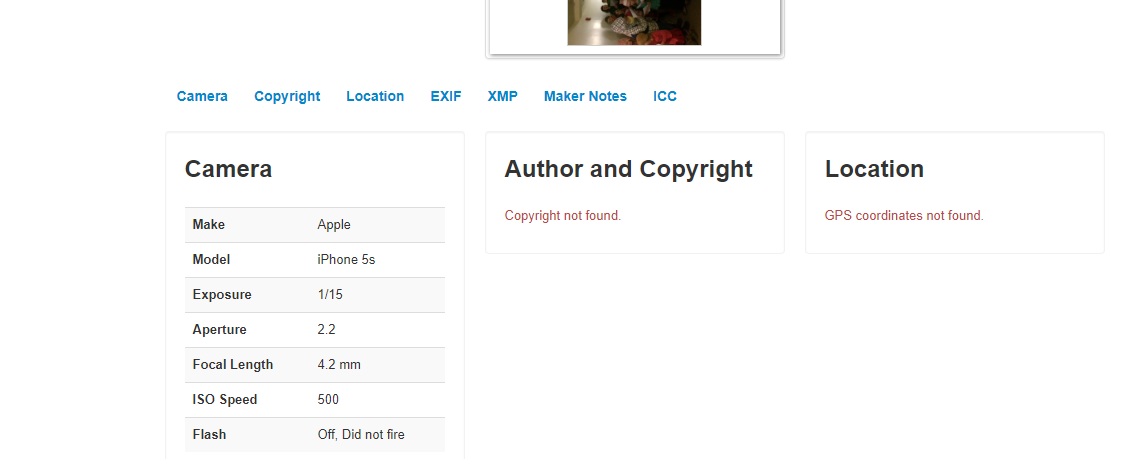
Hopefully your results will not have a location listed,
 though they may tell something about you
(such as what device you used to take the picture)


As you probably guessed, this is what you do NOT want to see--the location where your picture was taken hidden within the picture.


So what do you do if you find that your pictures are tagged already?  First of all, I'd google how to turn the tags off on your device.  You can also look online for how to remove the locations from the photos on your phone as well as on different applications (such as websites and etc.)  Some websites already remove the location info when you upload them (I think facebook does) but others don't.  I know some people aren't concerned about the locations on their pictures, but I am, and I just want to let you know that it exists and that you might really want to think about your policy on this privacy issue.  


Homeschool Collection {Monthly Round UP}

Homeschool Review Crew Weekly Link Up

Wednesday, June 27, 2018

The Master and His Apprentices: Art History from a Christian Perspective -- my REVIEW

Do you do art in your homeschool? How about art appreciation? Or art history? There are so many different things that can fit into the "fine arts" slot in our homeschools and many folks approach it differently.  We count things like music lessons, art classes, performance participation or attendance, and more within the realm of "fine arts" in our homeschool program.  As a matter of fact, after age 13 fine arts is not a requirement in our state for homeschoolers.

The curriculum that we got to review for this session is (you guessed it!) an art curriculum.  More specifically, it is an art history curriculum.  We were given the opportunity to try out The Master and His Apprentices: Art History from a Christian Perspective  which is a large book (or digital textbook and teacher book) which is intended to be used to give a high school student up to one credit of art history.  This resource is available from The Master and His Apprentices.  

The Master and His Apprentices

The way the curriculum is designed to be used is that the student reads the text and then completes questions about the segment read.  Occasionally there are exams (4 of them) as well as papers assigned (4 as well).  Accompanying the student text is a teacher's copy, which is super-handy!  It gives a very nice sample syllabus as well as weekly example for use for a year.

The sample schedule contains readings, assignments, and exams
There are worksheets that are for the student to use after he or she has read the assigned pages (or chapter).  We actually used them along with the reading, as a kind of guided note-taking type exercise (or maybe better stated that it was a way to highlight certain information while reading).  The GREAT thing about these is that in the teacher's manual there is an answer key for these!  Makes it so much easier for the teacher! :) 

The worksheets allow the student and teacher
to make sure highlights/important points are retained.
There are also exams which are combinations of question types: matching, fill in the blank, list, define, short essays, etc. so they nicely cover a variety of assessment types.  Answers to these are also included in the teacher's manual (yay!).

SO what types of things are taught in The Master and His Apprentices: Art History from a Christian Perspective ?  Well, a lot of topics.  The study begins with an talk about God being the Creator, the originator of all that is good and as such the "Master" of all art, with humans just his "apprentices".  The second chapter walks the student through the days of creation. The author espouses the Young Earth Theory of Creationism.

Chapter 2 is devoted to explaining the days of Creation

Chapters following this cover different artistic trends from ancient times up through about the 1700's.  That is a broad statement, but it is actually from pages 22 through 306.  Different styles of art throughout different historical periods are highlighted and illustrated.  Ancient Egypt, Minoans, Etruscans, Ancient Greece, and more!


Architecture, sculpture, paintings, and more are discussed along with cultural significances.  
Timelines are also printed, which are very helpful for seeing events/artists/periods in context.


When the time frames get up to about the 1200's, the author begins to teach about particular artists and some of their works, mainly to illustrate art trends of the period.

Oddly enough, when the book arrives at the 1700's, it kind of stalls out.  To illustrate my point, when we get to page 306, the chapter covers from the rococo period of the 1700's through today. . .in just 7 pages!!! Uhhhh..  The author does state that this chapter is to be used as a "springboard" to inspire students to do independent learning on some of the later trends and artists, but I found it a bit odd.

After the length of discussion about earlier times, the
discussion of more modern times seems quite brief to me..
My 13 year old daughter was the student who got to try out this curriculum.  She said that the first two chapters kind of seemed like a Bible lesson (yes) and not really like art.  As she went on in further chapters her remarks were that it felt more like what we had covered in ancient history classes (yes).  To get a feel for some of the later chapters she skipped ahead and read a bit about some of the different artists, which she thought felt a lot different than the earlier topics (more detail given to separate artists as examples of trends of their times).

I think that my suggestion regarding this curriculum would be to use it concurrently with a course in ancient history or history of western civilization.  I think it would be more impactful that way, as a supplement to the history studies. Yes, some would be a little redundant, but repetition helps with retention, right?  

One thing that sets this curriculum apart is that it intentionally does not include nudity.  Now, as we all know, nudity in art is not isolated to one time frame or just a few artists, but this author has chosen to not include nude representations in this book.  One part of me thinks this is fine, remembering when my kids were younger and they were a little shocked by some artistic portrayals, but then--does it represent the artists truly?  For instance, there is a section on Rubens which--when we hear the name Rubens, what do we usually think about? Large, plump naked women in his art, right? I know that is not all he painted, but I think culturally now that is what we usually associate with him.  But this is not addressed, leading me to wonder what other things have been left out in acquiscence with this theme.  Well, the author is not trying to mis-lead, it is made clear that it is intentional that nudity is left out, but, I don't know, are we missing something by just leaving this out?  


Wow, a whole section about Rubens without chubby naked females?

The product that we used for this review was a digital copy of both the student text and the teacher's manual.  I am not a huge fan of digital books for textbooks.  I'd rather have the physical copy; that being said, I do realize that you can print the electronic copy--we opted not to because it was just way too many pages for me to print :) (or to pay for having printed).  SO -- my comment on the digital copy (using it on a computer) is that it is a little difficult to use in the two-column form using Acrobat Reader--because it's two columns, you need to read down the column and then scroll back up to the top of the page to begin the second column.  Sounds really picky and shallow when I read what I just wrote, but it was a bit annoying :) I guess that's why I prefer physical copies!


So...for a wrap-up.  The Master and His Apprentices is a very Christian-based history of art, mostly from ancient times through the 1600's or so.  It is intended for a high school audience, whether homeschool or small class.  (***The front material states that it is intended for use by ONE student, if you wish to print the worksheets for further students the cost--at this time, at least--is $2 per student).  Added to the Christian distinctives is another distinctive in the world of art books, and that is not including nudity.  So if that's what you're after, you may want to look into this product.  

To read what other homeschooling families have to say about The Master and His Apprentices: Art History from a Christian Perspective, please click on the banner below!


The Master and His Apprentices: Art History from a Christian Perspective {The Master and His Apprentices Reviews}


Crew Disclaimer


Saturday, June 23, 2018

G is for Graduation . .. .PARTY!

There are so many different ways that homeschoolers mark their students graduation from high school.  Some have ceremonies, others just slide into the next phase (college or whatever)--for our family, we decided to have a big graduation party, rather than a ceremony or what have you.  Since it was to celebrate our daughter and her accomplishments we let her invite whomever she chose...about 180 people came!!!  Phew!

Thank the Lord we had a gorgeous weather day...and we did it all simple...hamburgers/hotdogs on the grill, pasta salad, fruit salad, potato chips, and yummy graduation cookies; to drink we had lemonade and water.  Pretty easy, simple to prep in advance, and lots to go around!


Lots of party games for the kids (thank you pinterest!) and just fun socializing for everyone! It was very simple, lots of fun, and great graduation memories for our daughter!


Saturday, June 16, 2018

Graduation cookies

Oh my! Instead of a graduation cake, we decided to make huge cookies for my daughter's graduation party. Oohh they were delicious!

Basically we made a sugar cookie recipe that didn't require chilling and made large circle cutouts (like 5 inch diameter!) and then gave them a thick frosting of buttercream frosting and covered the tops with sprinkles :) They were very delicious as well as festive-looking!  Time consuming, but a great addition to a special day!


Saturday, June 9, 2018

E is for eggs...and egg recipes!


For those of us who have chickens, this time of year is a time of plenty (of eggs!) following a season of more scarcity (of eggs!) In wintertime we keep a light on them to keep them laying, but we only get a few eggs a day...as opposed to now, when they are ALL laying (except for the one old lady hen who is 8 years old and has stopped laying, but we still like her anyhow!  She's been a good hen for us, now it's her retirement years :) )

ANYWAY!!! The point is that this time of year we have a lot of eggs!  Like 10 a day, and there are 5 of us in our family...so we're eating lots of eggs right about now!  :)  We have some basic staples (like fried eggs which are such a quick and easy breakfast), and of course scrambled, and what we call quiche, but is more like a fritatta (eggs scrambled with veggies, meats, and cheese, then baked).

Other times we find a new recipe and try it and love it! I have several posts about different egg recipes, such as:

Pizza Quiche: 


SO--this time of year we're always looking for new egg recipes!  Any of you have any favorites you'd like to share?  Please feel free to share in the comments or link to a post you have made with a recipe!


Thursday, June 7, 2018

Traditional Logic I and Traditional Logic II Complete Sets by Memoria Press -- my REVIEW

I have a child who is very deep-thinking.  Many times when he is reading his schoolbooks on various topics he'll stop and just stare off into space, trying to make connections and extensions of what he has read.  He loves debate and seeing things in the bigger picture.  He was very happy to get to use this latest review product, Traditional Logic I Complete Set and Traditional Logic II Complete Set (which he'll use when he is done with Logic I, of course!) which are produced by Memoria Press.

Traditional Logic I Complete Set

Traditional Logic II Complete Set

We have used a couple of products by Memoria Press before, and every time I am more and more impressed! 

You might read the titles of these courses and think that they are just for Classical Education systems, but I would like to tell you that is not true! We use quite a mix of materials in our homeschool, and this fits PERFECTLY in for us!

The materials that are included with these complete sets (I and II) are enough to allow you to help your child learn through this curriculum without you knowing everything about logic :) which is great for me!  Included with the sets are DVDs (which contains lectures on each chapter as well as the slides which are used in each chapter lecture), a student text, a student workbook, a teacher key (which contains the answers to the workbook pages, quizzes, and tests), and a quizzes and tests book (really just quizzes over each chapter and then a final exam). 

The workbook gives the student the instructions for each day: the first day is an overview day--the student reads the entire chapter and then answers some questions from the whole chapter.  The subsequent days the student focuses on particular sections of the chapter, looking more in depth at the different parts of the chapter.


Each chapter has its own section on the DVD, which include the author (Cothran) delivering a lecture overview of that particular chapter's contents.  
Same instructor in Logic I

and Logic II! :) 

The student of mine who used these materials was my 16 year old son.  He found that the way that worked best for him to complete each chapter was to do the Overview of the chapter (Day 1) on one day, then he often did days 2 and 3 in one day, Day 4 the next day, the review exercises and the DVD lecture on day 5 (and quiz).  It could be used daily, but that's the way that it fell into his schoolday most weeks!  He really enjoyed using the DVD lecture at the end of the chapter, because then he kind of had a wrap-up and it gave him a way to make sure that he had caught all the important concepts of the chapter. 

So since I just mentioned the concepts, you are probably wondering what kinds of concepts these logic courses cover, right?  If you look on the website or on the back of the textbooks, you will see that Logic I is described as  "an in-depth study of the classic syllogism."  If you're not really in the know as to the logic terminology of "syllogism," I would describe it as deductive reasoning.  Logic I introduces/teaches,  "four kinds of logical statements, the four ways propositions can be opposed, the three ways which they can be equivalent, and the seven rules for the validity of syllogisms" (quoted from their website, because they have said it in nice concise terms!)  It helps students learn these step-by-step methods of looking at different statements, especially when connected with other related statements.
  Logic II  is the companion product to Logic I, following directly after it (and recommended to be used by a student who has completed Logic I already).  Logic II is by the same author and is parallel in form to the Logic I materials.  It goes further than Logic I and incorporates more real-life examples and expands on the format of logic learned in the first course, covering more complex forms of reasoning, extrapolation, different methods of introducing and completing proofs, and more.  Students will learn the terminology of traditional logic and will be able to utliize these different ways of thinking through dilemmas and questions.
He will definitely be completing this second semester Logic (II) as well--he actually enjoys it and we see him utilizing it in his thinking about different things. 

I DEFINITELY recommend this series, Logic I and Logic II.  I appreciate that it is easy for me to teach, without my full background in logic--my student can benefit from the author/lecturer's expertise.  My son has found the chapters in the text to be easy to follow and understand, especially when used with the workbook in the overview/deeper reading/lecture format.  He enjoys the lectures and said that they are pretty interesting (high praise from a 16 year old!) and not dull at all.

Another thing that I like that is on the DVD is the slides that are used in the lecture.  Sometimes things flip past while you are watching and you don't get enough time to fully read them or you want to refer to them later -- the DVD contains these slides for your revew!

So in conclusion, I really like this curriculum.  I am excited that my son will be able to use these tools of logic throughout his other courses, and truthfully--throughout his life!  I am becoming more and more impressed with Memoria Press and thank them for their high quality, easy-to-teach/learn materials that they are producing!


To read other reviews about the logic courses as well as some other courses that Memoria Press offers (such as New American Cursive and Classical Composition) please click on the link below!


New American Cursive & Traditional Logic {Memoria Press Reviews}

Crew Disclaimer